
Landover Previous Residents by Era
The backward trail for a Landover address depends on the era. SDAT covers the current parcel's ownership and deed references. MDLandRec opens electronic and historical deed books, though its active electronic dates matter for any dated search. PGCMLS, the Prince George's County Historical Society, and the Maryland State Archives each carry different material: city directory volumes, census records, newspapers, plats, probate files, and older county records. None of them guarantees an exact Landover household result. Every resident lookup is a route, not a promise.
| Source | Years it covers | Where held | What it can show |
|---|---|---|---|
| SDAT parcel and deed reference | Current assessment and transfer information | Maryland SDAT | Recorded owner, premises and mailing address, parcel fields, sale and deed references |
| MDLandRec index and volumes | County electronic span varies; historical books reach earlier material | Maryland Land Records, courthouse, and Archives | Parties, date, book or page, legal description, and prior instruments |
| Prince George's release index | 1966-1994 for the separate CE411 series | Maryland State Archives | Agreements, assignments, notices, and releases in that separate index |
| Federal census | 1790-1950 currently public under the 72-year rule | PGCMLS databases and federal research channels | Household snapshot, relationships, and address context where available |
| County archive series | Series vary, including plats 1880-1975 and wills 1698-1979 with microfilm through 1997 | Maryland State Archives catalog and research room | Plats, probate, assessment, transfer, tax, and voter material |
| Permit history | Live date coverage not captured | Prince George's DPIE | Address-keyed activity, permit, license, or case references where released |
Match the starting point to the question. A property transfer calls for the Landover parcel record first. A historical household points instead to the library and archive channels. Either request gains precision from a date, a legal description, and the street's spelling. When an online result comes back empty, the next channel is usually a historical volume, a counter terminal, a catalog request, or a confirmed library holding.
Note: The Landover era table identifies research routes, not a promise that each source holds every address or person.
Landover Previous Residents Start With SDAT
For a current Landover address, SDAT Real Property Data Search is the first property record to pull. Choose Prince George's County, then search by address or street, account identifier, or map reference. Owner-name and ZIP searches are not supported. Enter the street name without directionals or suffixes. If an exact Landover search fails, try a truncated name with an asterisk.
Record the owner line. Record the premises and mailing addresses too. Note the account or PAN, map, grid, parcel, lot, block, subdivision, and plat. Capture the sale or transfer date, the seller, and the deed liber or folio. The owner shown is the last recorded deed owner. The mailing address serves correspondence and may sit elsewhere. Own-occupancy and tax-credit fields are assessment clues only, not proof anyone lived there.
These fields build a durable Landover address record. That holds even when a later source uses a different postal city label. The legal description, not the street name alone, carries the trail into older deeds and plats.
Landover Previous Residents in Deeds
A deed chain answers who held a recorded interest in the property. That is not the same as proving a full historical household. Begin at the current deed reference on the Landover parcel. Maryland Land Records can open an electronically indexed instrument by book or page. It can also search a party by name. Read the legal description and every prior-document reference. Do that before assuming a deed belongs to the same Landover parcel.
- Copy the Landover parcel's deed liber and folio, legal description, subdivision, lot, block, and transfer date from SDAT.
- Open the current deed by book and page in MDLandRec, or search the current owner as grantee around the transfer date.
- Record the seller, who is the grantor on that transfer, and compare the legal description with the parcel card.
- Search that seller as grantee to locate the prior acquisition, then repeat the comparison for each older transfer.
- When the electronic index ends, move to historical volumes, courthouse terminals, archive material, or a targeted request using the book and page clues.
The clerk's Land Records Division offers an in-person route at 14701 Gov. Oden Bowie Drive, Upper Marlboro, phone 301-780-2253, with listed weekday hours of 8:30 to 4:30. A free MDLandRec home account and the courthouse terminals are separate access paths. Judiciary guidance lists plain copies at $0.50 per page. The Clerk does not perform title searches or give legal advice.
- Grantor and grantee
- The grantor gives or transfers the recorded interest. The grantee receives it. Reading both roles correctly is essential when moving backward through a Landover deed chain.
- Chain of title
- A sequence of recorded transfers connected by the same legal description. It is a property-interest trail, not a census of people at the address.
- Legal description
- The lot, block, subdivision, parcel, plat, metes-and-bounds, or related formal description used in deeds. It can outlast an address change.
When Landover Deed Indexes End
In past residents research, an empty electronic search is a cue to change method. It is not a signal to stop. MDLandRec's electronic index and its historical "Jump to New Volume" function are different tools. The historical route reaches scanned book pages that are not fully name-indexed. A liber and folio copied from SDAT often bridges into that material. A later deed can do the same.
Prince George's County also has a specific release-index quirk. Agreements, Assignments, Notices, and Releases sit in a separate index for 1966 through 1994. That index is Maryland State Archives series CE411. Before 1966, releases are indexed on the related instrument. Use MDLandRec's official instructions to check name modifiers, date filters, historical-volume access, and this exception.
Maryland State Archives reported in 2025 on a project for Prince George's land-record filings. It created text-searchable PDFs for filings from 1950 through 1970. That work does not make the entire Landover deed record text-searchable. Historical-volume images remain part of the fallback chain. So do the Archives research room and paper or microfilm. Any street directory or household question may still need them.
Note: A Landover deed search needs a verified legal-description match. No older book page joins the chain without one.
Landover Previous Residents and Plats
Plats can carry a Landover address backward when the street wording shifts. Or a deed may list only a subdivision description. SDAT and the County GIS property layer hold the map, grid, parcel, lot, block, plat, liber, folio, and subdivision clues. A street-address search misses those. Recorded plats spell out roads, easements, lot lines, outlots, condominium phases, and parcel splits. For tracing past residents of Landover, they anchor a property to a legal description. The residents directory trail often depends on that anchor.
Open the County GIS property layer. Inspect the target Landover parcel and the polygons beside it. Then cross-check those fields in SDAT and the recorded plat itself. The live map publishes no radius or buffer tool, so do not count on one. A map view is a research aid. It is not a legal survey.
Plats.net and Maryland State Archives materials serve this step. The Land Records counter and historical paper or microfilm records serve it too. A non-indexed County record needs an MPIA request. That request should name the address, the date range, the record type, and the desired format. A focused question gives the custodian something retrievable. Vague requests slow any resident lookup.
Landover Previous Residents in Directories
Directories add the household layer once a deed chain establishes the property trail. Here Landover has a real gap. PGCMLS Discovery Suite describes HeritageQuest as including city directories, census data, and schedules. Ancestry Library Edition requires a library visit. The Prince George's County Historical Society DeMarr Library holds county-history resources and offers research assistance. No web catalog publishes a specific Landover directory run. None lists a reverse or criss-cross shelf number. No scanned Landover entry appears either.
The nearby leads are narrower than a Landover claim. A PGCMLS North Brentwood history cites a 1912 suburban directory. The Maryland State Archives guide lists a 1962 Polk's Laurel City Directory. Neither proves that any Landover address appears inside those volumes. Confirm each volume's title, year, and address coverage first. Check the index format too. Ask PGCMLS, DeMarr Library, or the Archives. A city directory citation deserves that check before it enters a past-residents trail.
When a volume does hold the address, keep the original street spelling as printed. Keep the abbreviation exact too. Use a reverse or criss-cross section only if that volume includes one. Then compare the entry's address against the Landover parcel's legal description and deed date. The historical collections themselves are cataloged in the Landover city directories collection.
Landover Previous Residents and Census
Census schedules can test a dated household lead. Pair them with the nearest directory year instead of treating them as a yearly record. Federal decennial census access runs 1790 through 1950 under the 72-year rule. PGCMLS resources, HeritageQuest, and other federal research channels open those schedules. The census is a household snapshot from one date. A directory, by contrast, is address-oriented evidence tied to its own publication year, which is what a Landover residents directory search usually needs.
- Write down the exact Landover address spelling and the period suggested by the deed, permit, or directory.
- Locate a verified directory or reverse-directory entry and keep the printed name, abbreviation, and address form intact.
- Pair that date with the nearest public census year and test the household against the address, community name, and other non-sensitive details.
- Check county newspapers, probate material, and deeds for a transfer, death notice, executor, or later address connection.
- Keep conflicting results separate until a property reference, time period, and identity all align.
Newspapers and probate can close a Landover trail. That happens when an owner or old household leaves the address. The State Archives and the Prince George's County Historical Society hold county-title leads. Register of Wills and Orphans' Court records identify estate roles. Archive series list county wills from 1698 through 1979, with microfilm through 1997. The Register of Wills has no online estate-search interface. That step runs through the office itself.
Landover Address Records and Maps
Maps and permits can date physical changes without replacing the ownership or household trail. The Prince George's Permit History by Address form accepts a house, building, or street number. It also takes a street name and ZIP. The form publishes no description of its result fields or date coverage. Keep claims limited to the address search itself. LookSee Property Explorer serves as an alternative when a file is not exposed online. An MPIA request does too.
Sanborn material is another map lead, not a confirmed Landover source. Maryland State Archives describes general Maryland towns and cities on microfilm from 1885 through 1963. The Library of Congress collection is arranged by state, city, and date. No catalog lists a Landover-specific sheet or year. Search the Library of Congress Sanborn collection and the Archives by the relevant city or community. Go further only once a sheet is known to exist.
See the Prince George's County Land Records office source for the Landover previous residents record trail. Its counter access is listed there too.
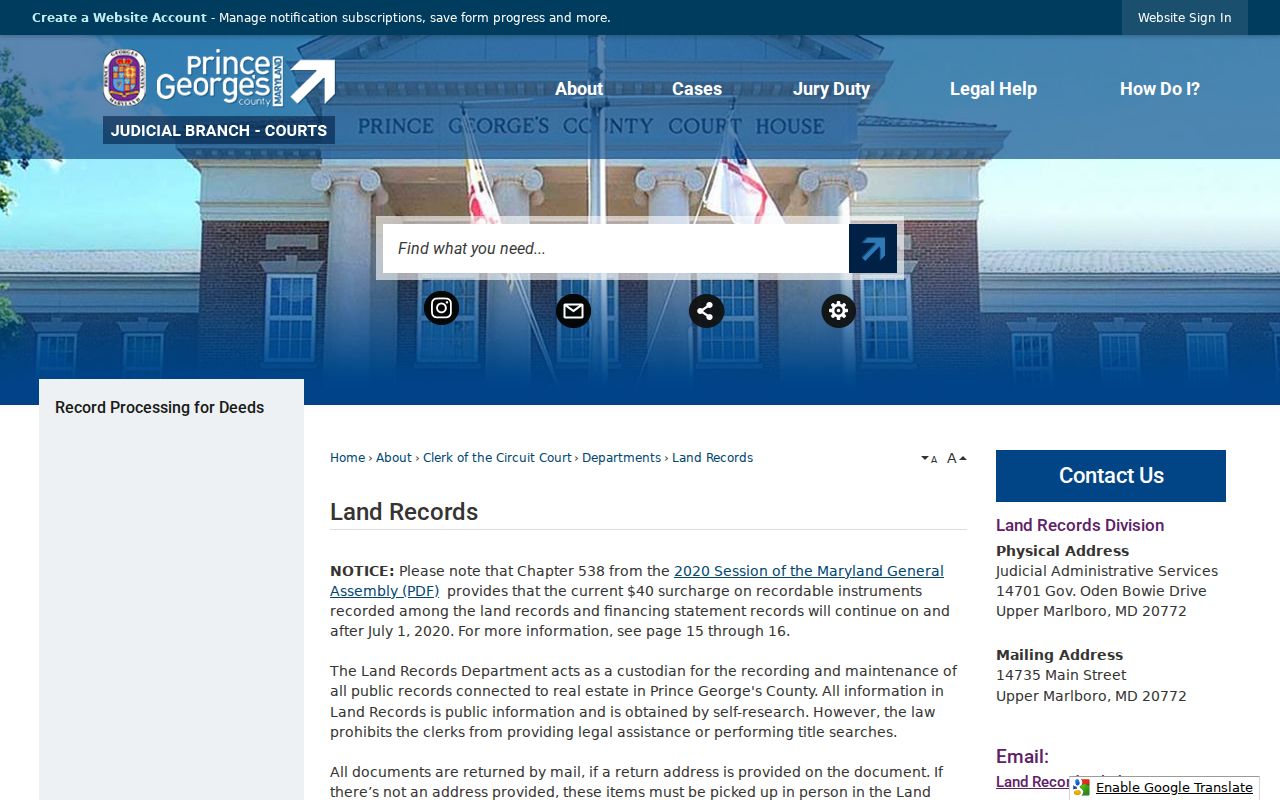
The Land Records counter, historical books, and Archive channels matter when a Landover address will not resolve through a current screen. Those older holdings often hold the past residents of Landover that no database indexes.
Note: Do not claim a Sanborn sheet covers a Landover address until a catalog or image confirms the city and date.
Landover Previous Residents Record Depth
Prince George's County keeps one of the stronger record trails in the region. The County dates to 1695, and its first court session came a year later. Maryland State Archives history notes no courthouse fire there. That alone sets it apart from counties where flames wiped out whole series. Preservation, though, is not the same as searchability. Many surviving records still sit in archival volumes rather than online, name-searchable indexes.
The archive guide covers wills, tax records, transfer books, assessment material, and voter lists. Subdivision and plat series run over long spans as well. Landover-area growth after World War II complicates any single address trail. One property can pass through rural, subdivision, and suburban record eras. For an older deed, the lot, block, subdivision name, map, and grid often matter more than a modern Landover postal label. The liber or folio matters just as much. A postal address can shift; the legal description rarely does.
For older material, Maryland State Archives staff and catalog tools are the documented route. Bring Prince George's County, the Landover address or legal description, and the record series if known. A date range helps too. Charges for research-room work and copies vary. Confirm the current handling process with the Archives before you plan a visit.
Landover Past Residents Lawful Use
Landover past-residents research serves family history, estate and heir questions. It can also trace the story of one address. It should not become a claim about a living person. An ownership record is not a verdict on anyone today. Nor is a historical directory lead or a public index. Where possible, lean on two independent records. If a record looks wrong, ask the original custodian to correct it.
Real boundaries exist. Protected addresses, restricted records, private customer data, and incomplete digital coverage all set limits. Any lookup can show only so much. A current assessment owner may not reflect a historical household. A deed can nail a transfer. Yet it may say little about who actually lived there day to day. A missing index result may simply mean the material sits in a historical volume, an archive, or a counter file. Or it may sit nowhere public at all.
Lawful use. Use Landover past-residents records for personal, lawful research such as family history, estate matters, or address history. Never use what you find to stalk, harass, intimidate, or harm anyone.